
When Kate Bean of Old Beach first started caring for orphaned wildlife, she didn’t know what sort of feeding bottle teats she should use for the different species of animals.
Local resident starts Wildlife Teats Tasmania

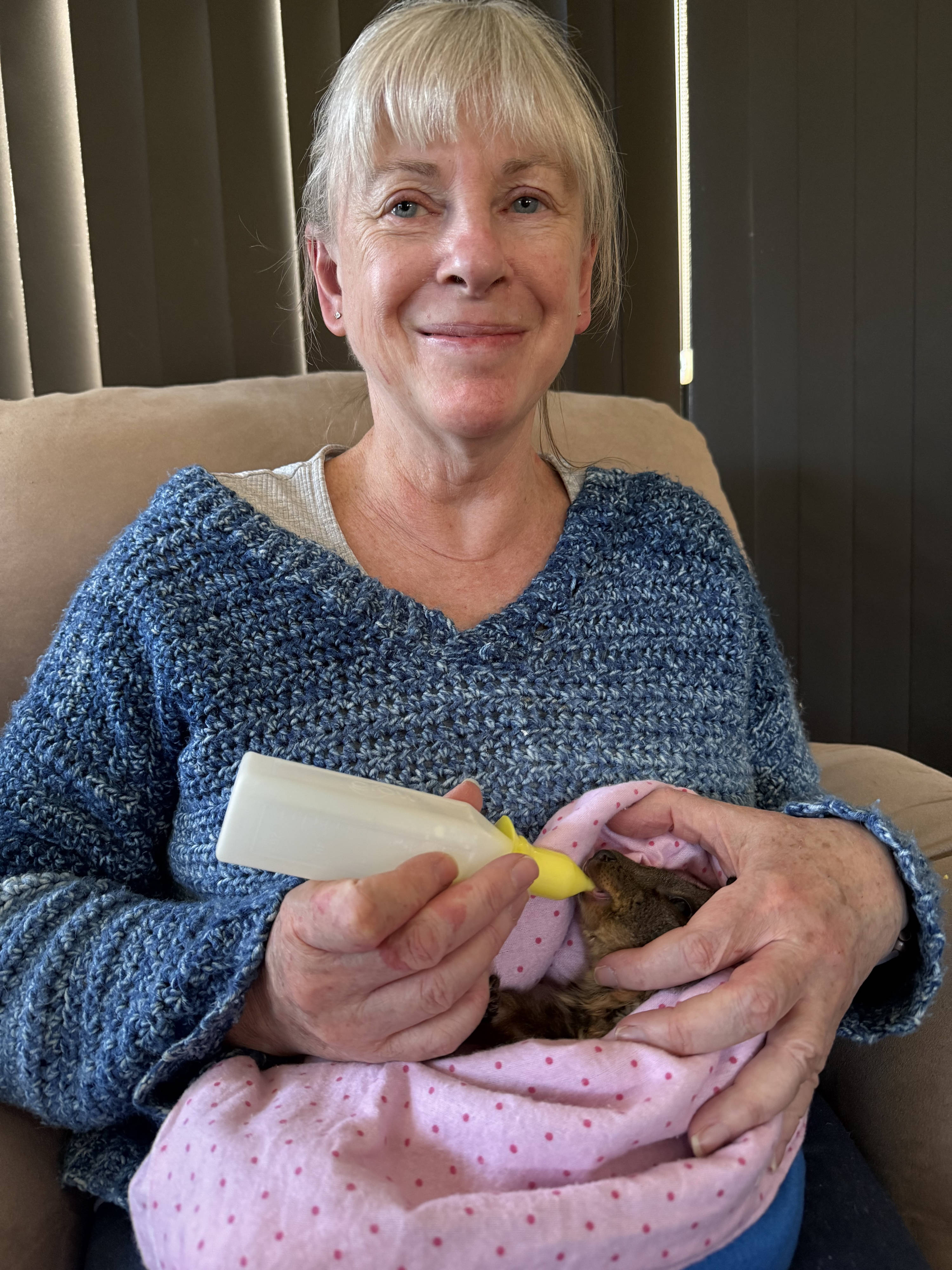
Kate had previously fostered neonate (newborn) kittens for Ten Lives Cat Centre. ‘With a kitten it’s easy,’ she said. ‘But there are so many different kinds of wildlife out there, of all shapes and sizes. And there was no one in Tasmania supplying the variety of teats. It was very frustrating.’
Wildlife Teats Tasmania grew out of that frustration, and out of a desire to make it easier for other new carers.
Kate’s partner Randall Preuss already owned several 3D printers, so he created a number of different sized moulds with letters on them, like P for pademelon and PP for possum, so carers know what sort of animal they can be used for.
To make the teats, the moulds are dipped in food safe silicone, left to cure for about 20 hours, then dipped again. ‘We do that three times,’ said Randall. ‘But the teats for young wombats get four coats because wombats are particularly chewy!’
‘The syringe teats, the really small ones, can be used for tiny animals like antechinus,’ said Kate. ‘We also make them for bandicoots, ringtails, brushtail possums, pademelons, Bennett’s wallabies, Eastern grey or forestor kangaroos, and wombats.’
‘Some people use latex, but that only lasts for 12 months, whereas silicon will last you for the life of the animal in your care. That makes the cost less of a burden for carers. And silicon is a lot more durable. You can sterilise it, boil it and microwave it.’
There’s an art to making the teats, and Kate and Randall have learned a lot along the way. ‘We’re finding that a lot of older carers are having issues with their hands. So we’ve added a little flange around the bottom of the teats to make it easier to push them onto a bottle.’
They see what they do as a hobby rather than a small business, but their silicon teats now go all over Australia. They also offer a number of free ones to Animal Rescue Cooperative Tasmania (ARC), for handing out to other carers.
According to Kate, 2025 has been a particularly hectic season for carers, because of the wind. ‘Possum joeys get blown out of trees, or they fall off their mums and are found at the bottom of a tree. And roadkill numbers are sadly still high.’
‘If someone who isn’t a wildlife carer wants to help, they can donate a teat for a wildlife sanctuary or animal rescue on our website.’
Kate and Randall have been chosen by Clarence Climate Action as this month’s Climate Champions, for their work in supporting wildlife carers and conservation.
Anyone interested in becoming a wildlife carer or rescuer should contact Bonorong Wildlife Sanctuary.
Eastern Shore Sun, December 2025, page 21